


|
| ########################################## |
| A. INTRODUCTION |
| B. HOMOLOGATION, CERTIFICITION, DESIGN CATEGORY AND |
| B.01 EXPLANATION OF MANUFACTURER’S PLATE |
| B.02 TECHNICAL DATA OF “NES 21 MY” |
| B.03 DEGREES OF DANGER |
| C. DESCRIPTIONS OF BOAT, ESSENTIAL EQUIPMENT AND FEATURES |
| C.01 CONSTRUCTION |
| C.02 DECK FITTINGS AND GENERAL INFORMATION |
| D. PROPULSION SYSTEM |
| E. SYSTEMS AND CIRCUITS |
| E.01 ELECTRICAL SYSTEM |
| E.01.1 ELECTRICAL SYSTEM FILES |
| E.02 FUEL SYSTEM |
| E.02.1 Safety Advice On Filling Fuel Tank |
| E.03 VENTILATION SYSTEM |
| E.04 BILGE PUMPING SYSTEM |
| E.05 STEERING SYSTEM |
| E.06 FIRE EXTINGUISHING SYSTEM |
| E.07 LIFERAFT STOWAGE AND EMERGENCY ESCAPE |
| E.08 OTHER SPECIFIC INSTALLATIONS |
| F. ANCHORING ARRANGEMENT |
| G. SPECIFIC MANUALS |
| H. ENVIRONMENTAL CONSIDERATIONS |
| I. OPERATING YOUR BOAT |
| I.01 FIRST CHECK |
| I.02 ELECTRICAL SYSTEMS |
| I.03 AT THE PORT |
| I.04 SUITABILITY |
| I.05 VIBRATIONS |
| I.06 SHIFTING |
| I.07 FIRST OPERATING HOURS |
| J. SAFETY |
| J.01 OPERATOR’S RESPONSIBILITIES |
| J.02 OVERLOADING |
| J.03 WEATHER |
| J.03.1 What To Do In Severe Weather |
| J.04 STAYING AFLOAT |
| J.05 WHAT TO HAVE ON BOARD ? |
| J.05.1 Life Jackets |
| J.05.2 Fire Extinguishers Maintenance |
| J.06 VISUAL DISTRESS SIGNALS |
| J.06.1 Pyrotechnic Devices |
| J.06.2 Non-Pyrotechnic Devices |
| K. CARBON MONOXIDE HAZARD |
| L. MAINTENANCE |
| L.01 MARINE ENVIRONMENT |
| L.02 CLEANING |
| L.03 BELOW WATERLINE |
| L.04 BILGE |
| L.05 COCKPIT PERSENNING |
| L.06 STAINLESS STEEL |
| L.07 REPAIRS |
| L.08 CORRECT MATERIALS AND COMPONENTS |
| L.09 WINTER STORAGE |
| M. INSPECTION |
| N. LAST REMARKS |
| O. OTHER (OWNER’S GUIDE & INSTALLATION INSTRUCTIONS) LINK AND PDF FILES |
| P. WATER SYSTEMS |
| P.01 GRAY WATER TANKS |
| P.02 BLACK WATER TANKS |
| ########################################## |
| A. INTRODUCTION Thank you for choosing a NES TEKNOLOJI Ltd. boat .This manual is for motorboat NES 21 MY, built by NES TEKNOLOJI Ltd. to design category “B”. This manual has been prepared to help you operate your boat safely and with pleasure. It contains, details of the boat, the equipment supplied or fitted, its systems, and information on its operation and maintenance. Please read it carefully and familiarize yourself with your boat before using it. If this is your first motorboat, you are changing to a type of boat you are not familiar with, for your own comfort and safety, please ensure that you obtain handling and operating experience before assuming command of the boat. Your dealer or your national sailing and motor yacht association or yacht clubs can inform you about local boating schools and training offers. An owner’s manual is a technical document that describes a boat and its technical systems. It helps the skipper to operate the boat and its systems safely and it enables to identify and repair defects. It also contains maintenance and safety information. But an owner’s manual can not replace the necessary knowledge of seamanship which is beyond the scope of this manual ------------------------------------------- PLEASE KEEP THIS MANUAL IN A SAFE PLACE AND HAND IT OVER TO THE NEXT OWNER IF YOU SELL YOUR BOAT ------------------------------------------- |
| B. HOMOLOGATION, CERTIFICITION, DESIGN CATEGORY AND ---------------------- HIN : TR –NES21MY1E909 ---------------------- Built by : NES TEKNOLOJI Ltd. Tersaneler Bölgesi Aydıntepe Mahallesi Yakut Sokak No:5 İçmeler Tuzla-Istanbul/TURKEY Category of design B (Offshore) Your boat has been certified to be in compliance with the revelant parts of the Recreational Craft Directive 94/25/EC ammended by 2003/44/EC of the European Parliament. The CE mark on your boat mean that NES 21 MY meets or exceeds applicable ISO ( International Standards Organization) standards available at the time of manufacture. NES 21 MY has been tested in regard to stability, freeboard, buoyancy and flotation according to EN ISO 12217-1 so that, the requirements for the number of persons allowed and the additional loading could be determined. |
| B.01 EXPLANATION OF MANUFACTURER’S PLATE The manufacturer’s plate, which is fixed near the main steering console, looks like the following: 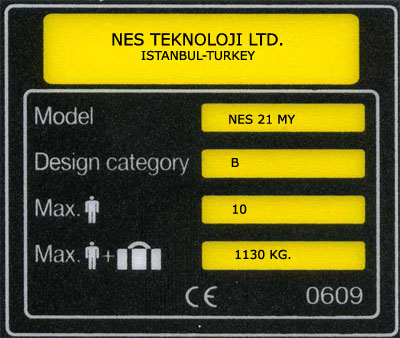 Design Category B The boat was built for the category of design C (inshore) Category B: Category for boats considered as suitable for significant wave heights up to 4 meter and wind speeds of Beaufort Force 8 or less. Max.  = 10 Maximum number of persons recommended = 10 Maximum number of persons recommendedMax. +  =1130 kg =1130 kgMaximum load : Including passengers, personal equipment, provisions and other loads (without fuel tank capacity). |
| B.02 TECHNICAL DATA OF “NES 21 MY” Length Overall : 22.00 m. Length Waterline : 1 9. 00 m. Beam : 6.00 m. Draught : 1.00 m. Engine. Power : 2x809 kW Max. Load : 1130 kg. Max. No of people : 10 Battery : 24 V – See your engine’s manual for recommendation |
| B.03 DEGREES OF DANGER Throughout this manual, specific precautions and symbols identify safety related information. Following Safety Warnings are found: 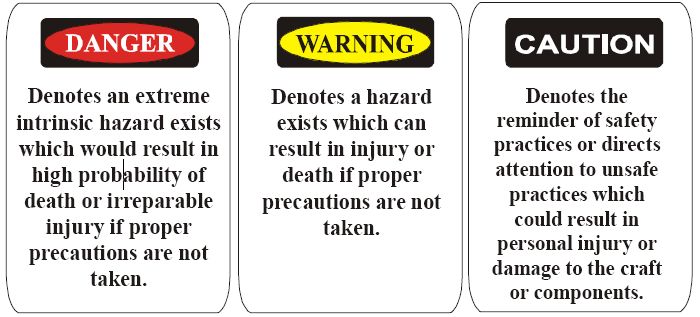 When you see any of the above signs within this manual, pay special attention to the points mentioned. Also, your boats has a number of safety related decals on many locations, warning operators and passenger of possible safety hazards. |
| C. DESCRIPTIONS OF BOAT, ESSENTIAL EQUIPMENT AND FEATURES |
| C.01 CONSTRUCTION NES 21 MY’s hull is built with the most modern techniques of wooden boatbuilding.The method is called cold-moulding with various layers of massive wood laminated with epoxy.Through out the production of the hull,deck and interior, various species of massive mahogany,cherry wood and cherry veneer is used .The plywood used at the interior is of high grade marine plywood .All the joints at the boat is covered with radiused epoxy putty .The outershell of the boat is laminated by e-glass and epoxy. Walking surfaces outside are made up of teak. |
| C.02 DECK FITTINGS AND GENERAL INFORMATION Anchoring is done by the anchor(45 kgs.)and anchor winch with main electrical control from the helm station.There are mainly four bollards two at the bow and two at the stern(two electrical winches/capstans,1000 watts each) for mooring,and also two at the sides.The hatch at the front deck is for getting inside the chain locker and the circuit breakers for the boaw thruster and anchor windlass.The front cabin has a bed for two with its own WC-shower room.At the back of the front cabin at port and starboard side there are two guest cabins with a WC-shower room at the port.The owner’s suite is towards the middle of the boat just in front of the engine room bulkhead. The accommodation for the crew is at the stern part of the boat(Lazarette)with two cabins and own wc-shower compartments.The access to this area is from the swim platform. Thru the crew cabin is the entry for the engine room with a watertight door and the access to the rudder room is under the stairway from the swim platform to the crew area. At the deck level there is a helm station found at the port side of the steering room with the electrical panels, electronics and controls for the engine and accessories.Access to this area is from the dining salon or from the water tight deck door at the starboard side or from the salon door.The electrical panel containing the main electrical switches is found at the port side of the steering station. The galley with an electric cooker,refrigertion and freezing units is at the port side of the boat just aft of the steering room .Entry is from the main saloon or from the water tight deck door at the port side. From the aft cockpit,at the starboard side the entry to the spacious flybridge is via ladders.At the flybridge a second steering console is equipped at the starboard.At the back of the radar arch port and starboard there are two liferafts,at the back part of the flybridge,there is a crane for lifting a jetski or RIB.  -Incase of an attept to leave the cockpit when the boat is underway,there is a high risk of falling from the sides or from the stern that may result in injuries or loosing of life. 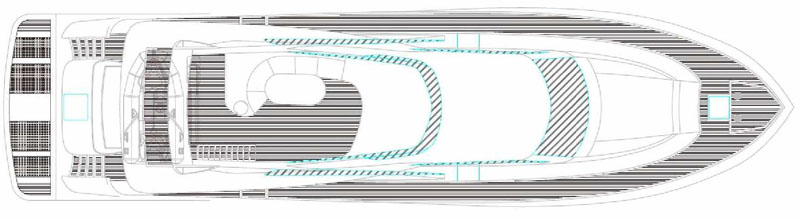 -a general view of the boat looking from top |
| D. PROPULSION SYSTEM NES 21 MY is designed for inboard motor and classical shaft propulsion.The boat is equipped with a pair of 809kW MAN Diesels. Detailed information about your inboard motor is found in its Owner’s Manual. Please refer to this manual and learn the necessary information about your engine. Never forget the danger that boat propellers can inflict to persons in the water. Remember to shut off your engines when approaching swimmers, or you or somebody else is trying to remove debris from your propeller. When your boat’s engine is running, alert swimmers to stay clear off the stern.Watch your step before you enter to the swimming platform,if it is moving please donot touch to the moving parts. -There is a high risk of injury or loosing life if you step between the boat and the lifting swimming platform. 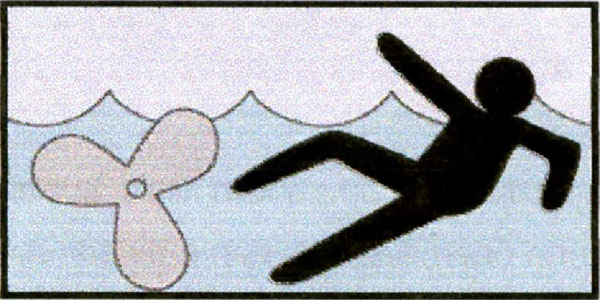 Therefore, the best and safest course of action to take when people are in water near your boat-Shut off your engine! |
| E. SYSTEMS AND CIRCUITS |
| E.01 ELECTRICAL SYSTEM Your boat is equipped with a pair of 19kW KOHLER Gensets for 220V and also 24V batteries.Please look for the batteries plan. A mains cut off switch is provided near the steering console. This cut-off switch disconnects the batteries from the electrical system of your boat. When your boat remains in the water, leave bilge pump switches at Auto position for automatic operation if you have an automatic bilge pump. Please check out the following diagrams for your boats electrical wiring diagrams,if there will be a need for electrical maintenance or additional equipment with electrical coonections will be installed,call a professional electrician to do the work.Never allow people that arenot qualified for this job to touch to your electrical circuits,wires and switches.  Battery acid is corrosive, so you have to protect eyes and skin if you have to work on it. You must rinse splashes of acid with fresh water and consult a doctor immediately. You can neutralize splashes of acid on the skin or on clothes with acid transformer or soapsuds. If one has drunk acid, please contact your doctor immediately. Check and top up acid level periodically. Check from time on time if the battery terminals have tight sit and if there are corrosion patches. 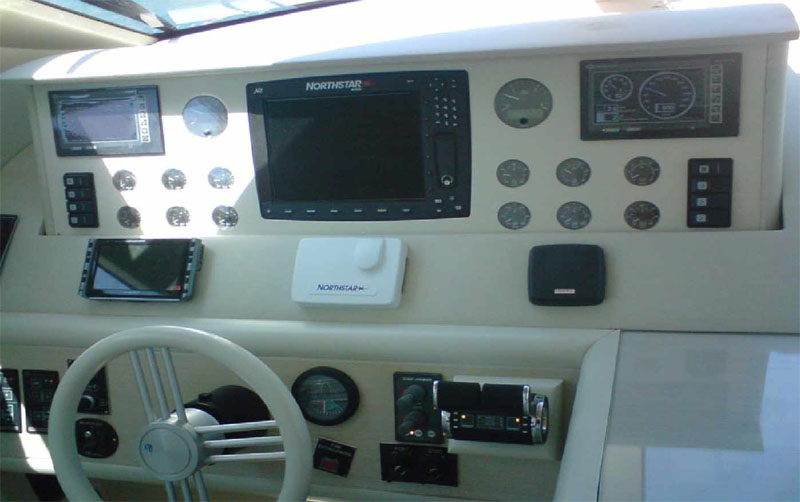 -NES 21 MY’S steering console with the instrument panel and electronics  -NES 21 MY’S electrical distribution panel and electric switches 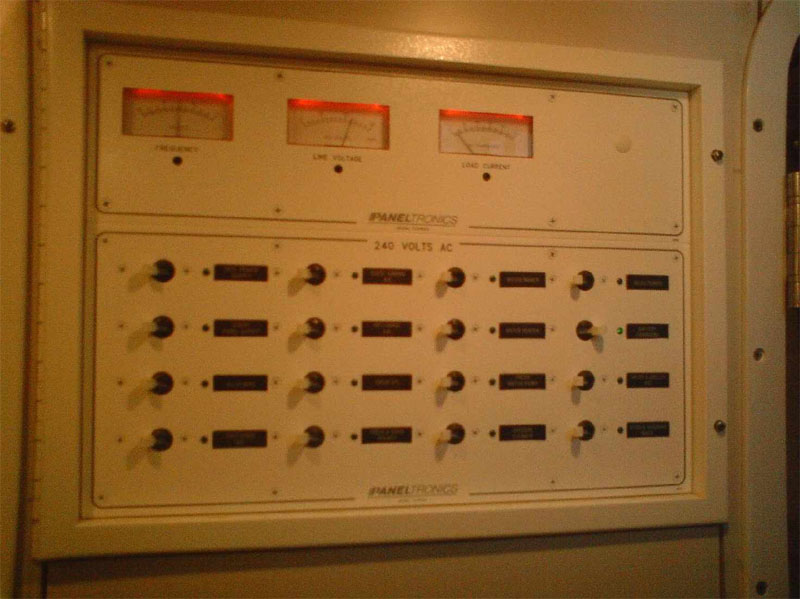 -a general view of the AC electrical panel at the engine room 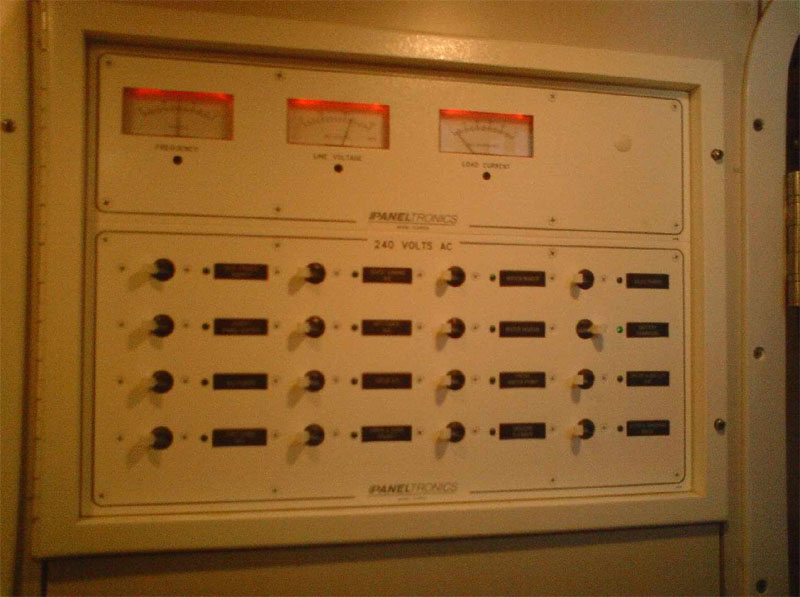 -a general view of the DC electrical panel at the engine room 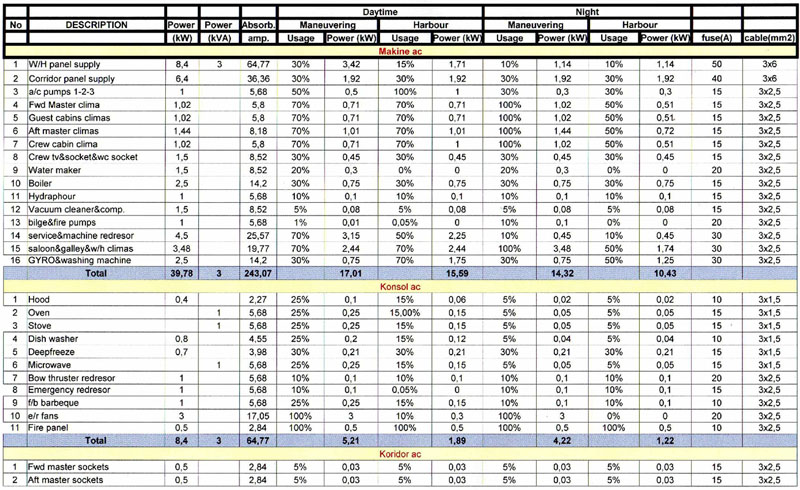 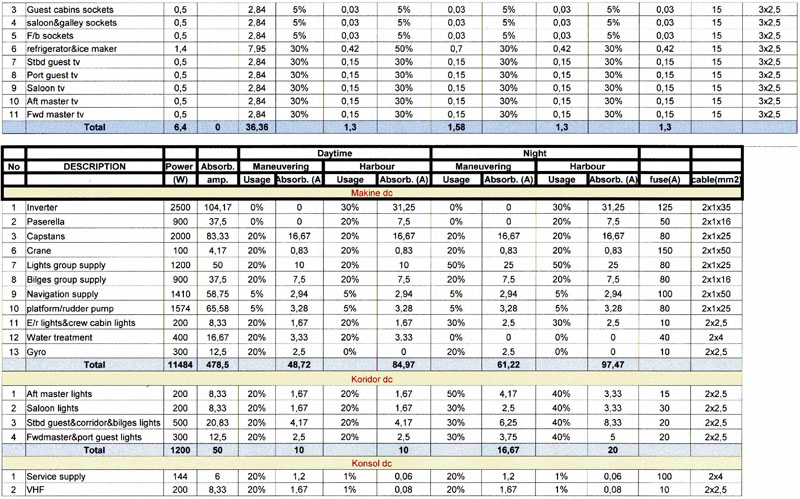 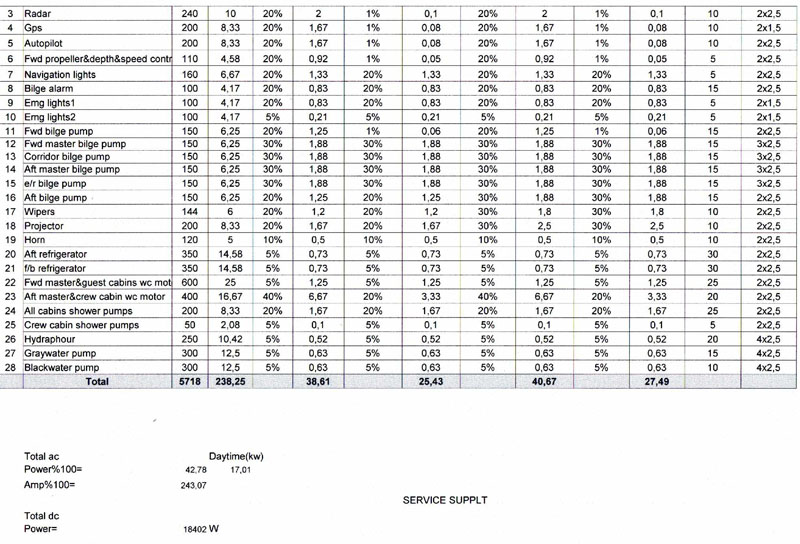 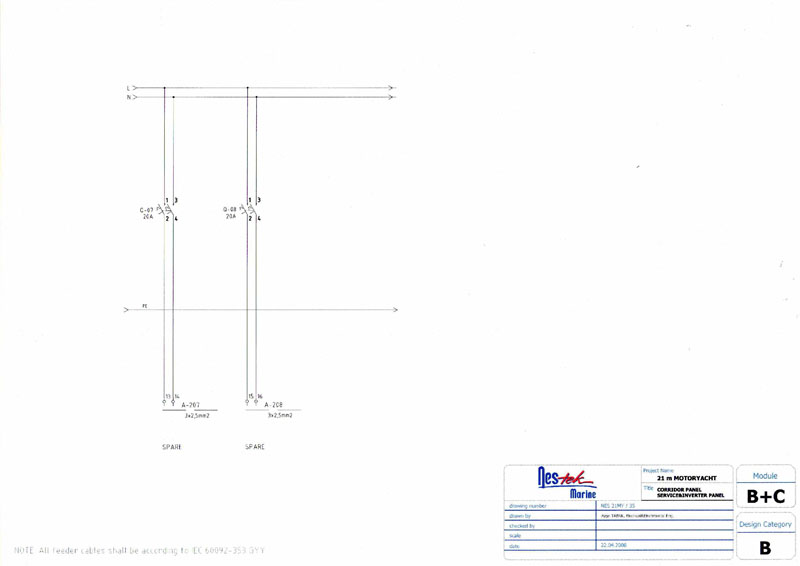 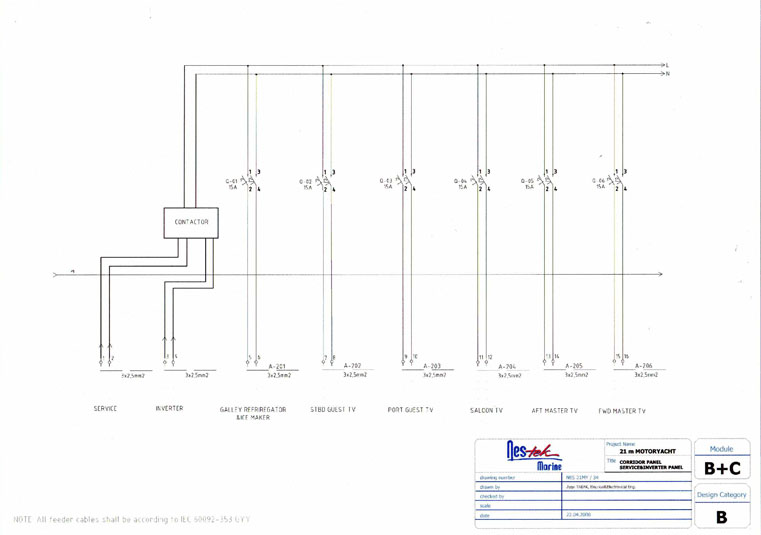 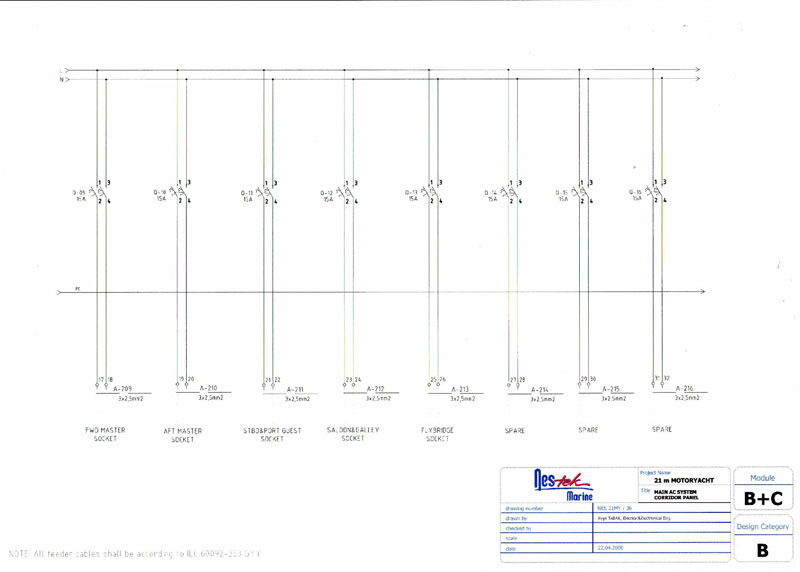 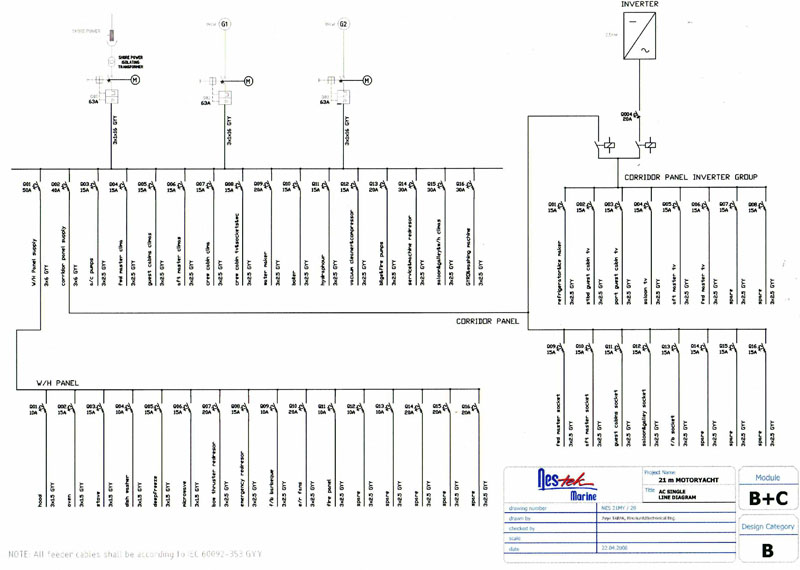 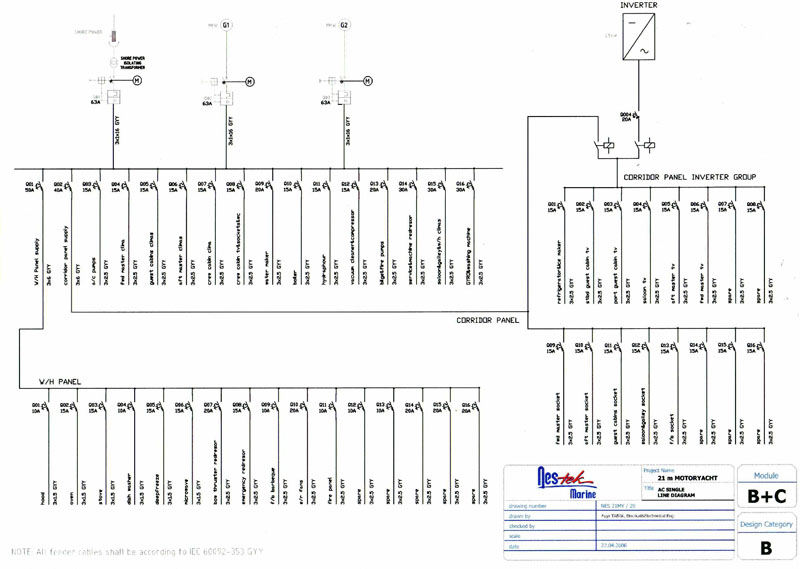 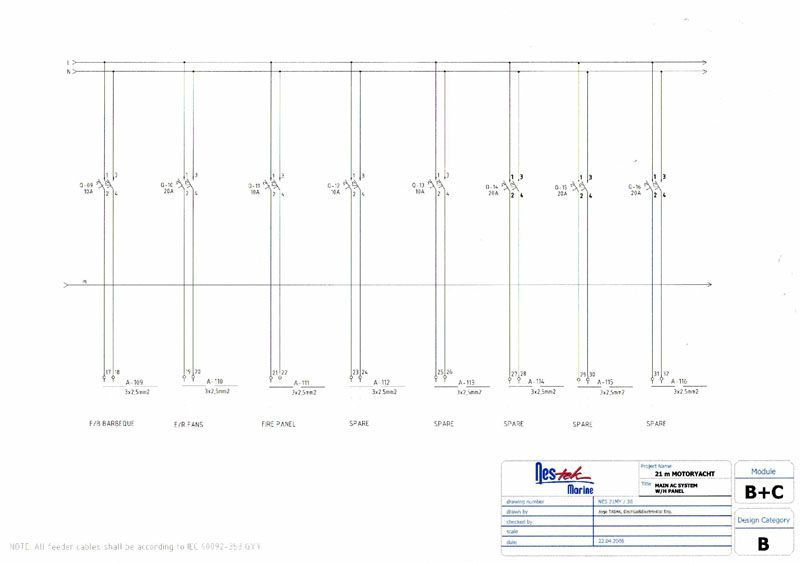  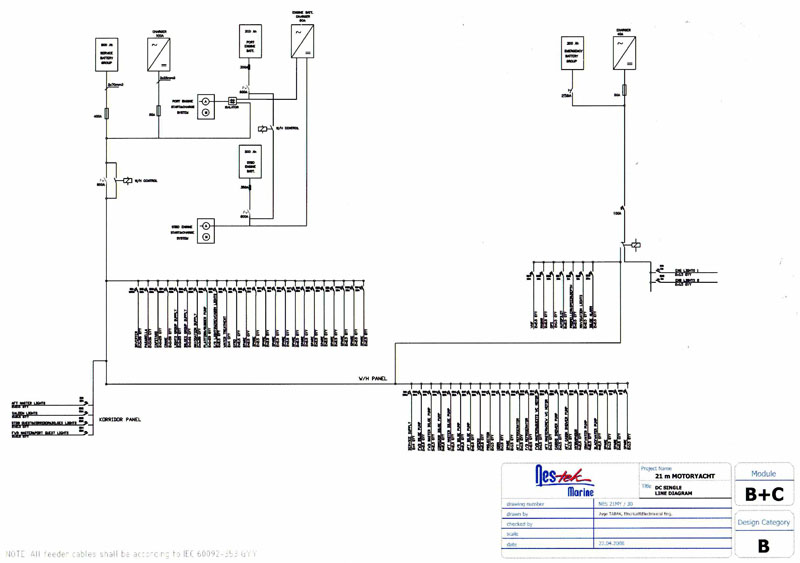   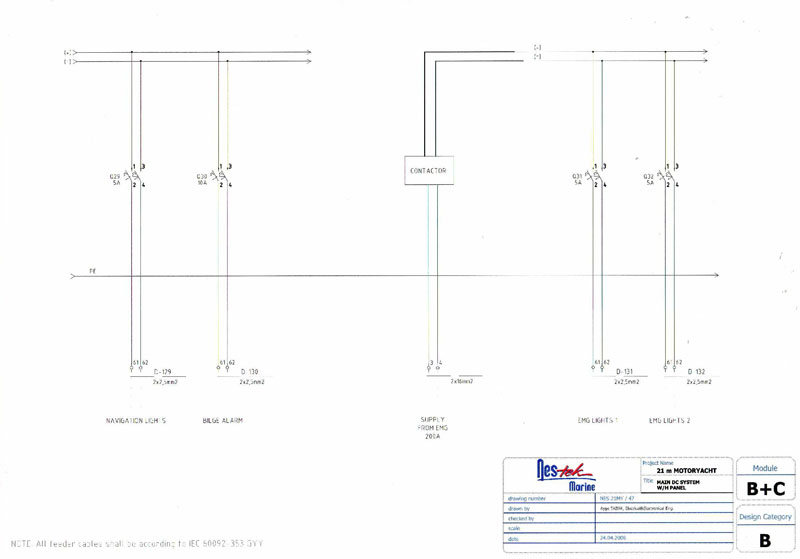 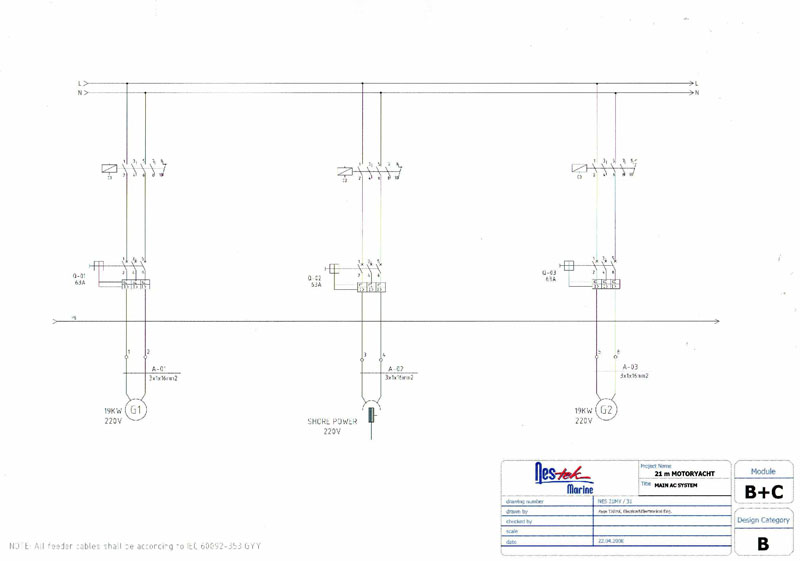 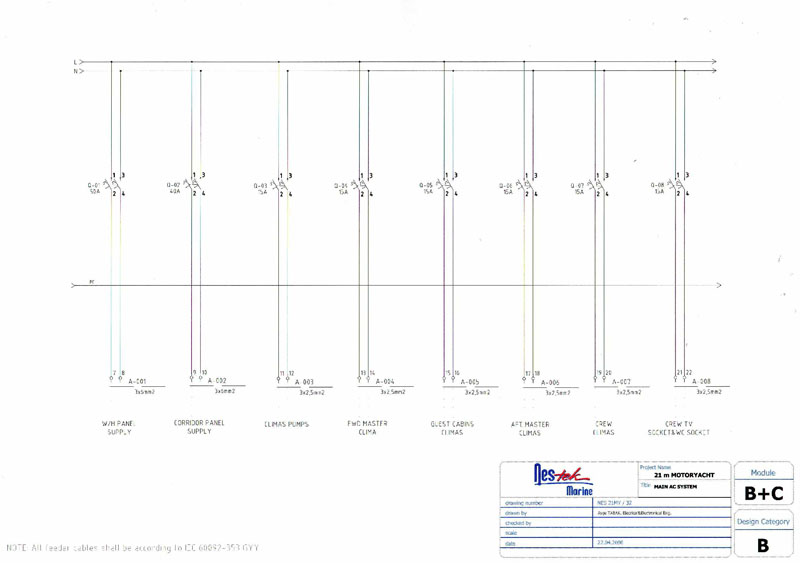 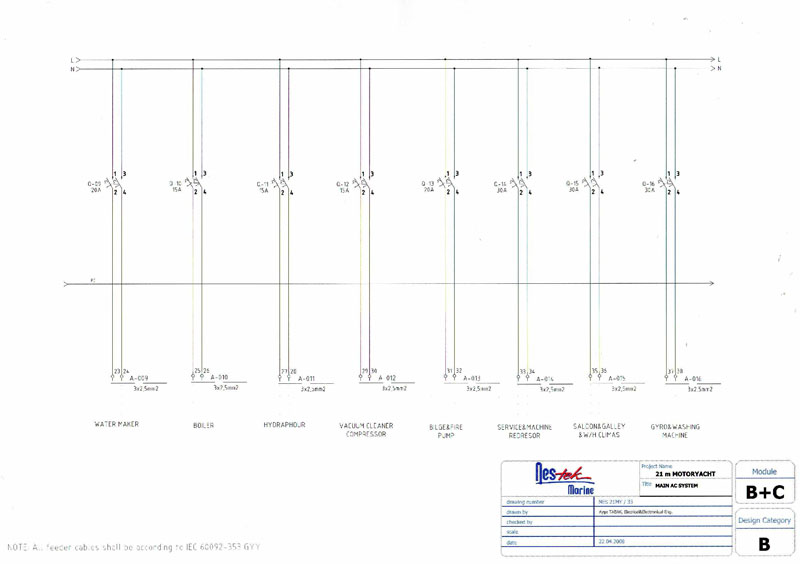 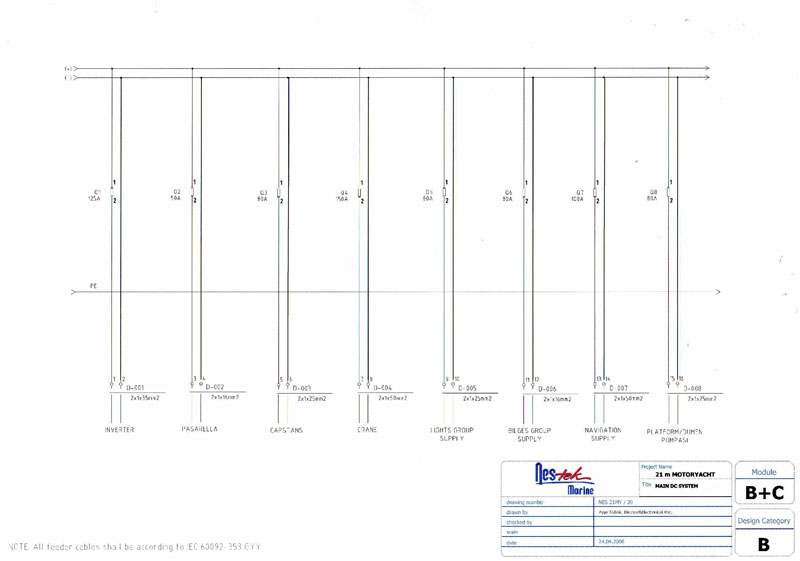 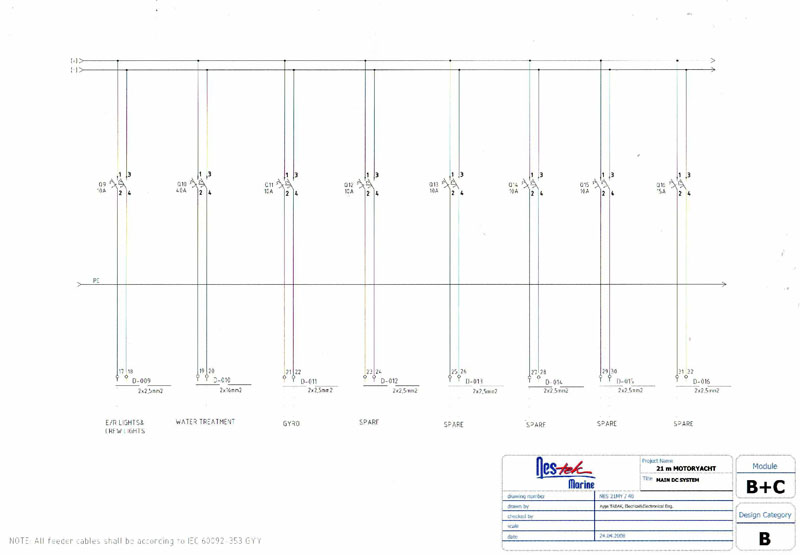 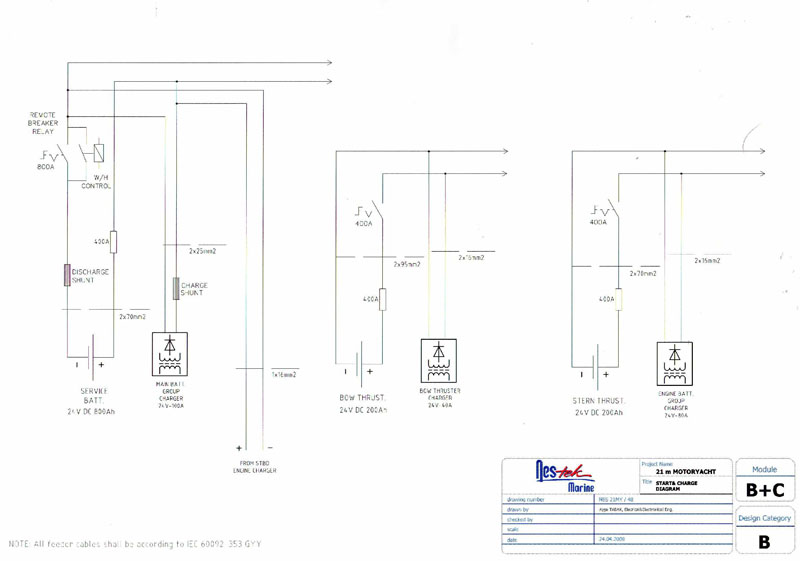  |
| E.01.1 ELECTRICAL SYSTEM FILES . LOAD ANALYSIS EXCEL FILES , . LOAD ANALYSIS PDF Files . MAIN AC 1 AUTOCAD FILES , . MAIN AC 1 PDF Files . MAIN AC 2 AUTOCAD FILES , . MAIN AC 2 PDF Files . MAIN AC 3 AUTOCAD FILES , . MAIN AC 3 PDF Files . MAIN DC 1 AUTOCAD FILES , . MAIN DC 1 PDF Files . MAIN DC 2 AUTOCAD FILES , . MAIN DC 2 PDF Files . MAIN DC 3 AUTOCAD FILES , . MAIN DC 3 PDF Files . AC W H 1 AUTOCAD FILES , . AC W H 1 PDF Files . AC W H 2 AUTOCAD FILES , . AC W H 2 PDF Files . DC W H 1 AUTOCAD FILES , . DC W H 1 PDF Files . DC W H 2 AUTOCAD FILES , . DC W H 2 PDF Files . DC W H 3 AUTOCAD FILES , . DC W H 3 PDF Files . DC W H 4 AUTOCAD FILES , . DC W H 4 PDF Files . DC W H 5 AUTOCAD FILES , . DC W H 5 PDF Files . AC CORRIDOR AUTOCAD FILES , . AC CORRIDOR PDF Files . DC CORRIDOR AUTOCAD FILES , . DC CORRIDOR PDF Files . AC CORRIDOR SERVICE&INVERTER AUTOCAD FILES , . AC CORRIDOR SERVICE&INVERTER PDF Files . AC CORRIDOR SERVICE&INVERTER 2 AUTOCAD FILES , . AC CORRIDOR SERVICE&INVERTER 2 PDF Files . AC SINGLE DIAGRAM AUTOCAD FILES , . AC SINGLE DIAGRAM PDF Files . DC SINGLE DIAGRAM AUTOCAD FILES , . DC SINGLE DIAGRAM PDF Files . START & CHARGE 1 AUTOCAD FILES , . START & CHARGE 1 PDF Files . START & CHARGE 2 AUTOCAD FILES , . START & CHARGE 2 PDF Files |
| E.02 FUEL SYSTEM Your boat is equipped with four stainless steel fuel tanks at port and starboard side sections of the engine room with a capacity totaling 4800 liters.Tank numbers P1 and P2 is found at the port of the engines,P1 having a capacity of 1025liters and P2 1375liters,whereas S1 and S2 at the starboard of the engines,S1 having a capacity of 1375liters and S2 1025liters..All the tanks are connected to the system with stainless steel tubes(collectors) and ball valves(see the attached pictures for the fuel system).The access to the tank’s man holes are simply by taking the screws away from the panels.Your gensets are also fuelled from the same system.Please check the following page named fuel system for an overview of your boats sytems. For starting and other information, please consult your inboard motor’s owner’s manual. |
E.02.1 Safety Advice On Filling Fuel Tank  First you should care that your boat is moored safely at the jetty. In every case the engine must be switched off while filling the fuel tanks. While filling and at the filling station smoking is absolutely forbidden: after having filled up the fuel tanks the fuel tank area must be aired for at least 5 minutes Fueling Precautions · Portable tanks that may be existing at the boat should be refueled ashore. · Close all hatches and other openings before fueling. · Extinguish all smoking materials. · Turn off engines, all electrical equipment, radios, stove and other appliances. · Remove all passengers. · Keep the fill nozzle contact with the tank and wipe up any spilled fuel. · Check the bilges for fuel vapors before starting the engine. · Do the “sniff test” .Sniff around to make sure there is no odor of gasoline anywhere in the boat. · Do not start the engine until all traces of fuel vapors are eliminated. · Fuel Management Practice the “One-Third Rule” by using: · One-third of the fuel going out. · One-third to get back and · One-third in reserve 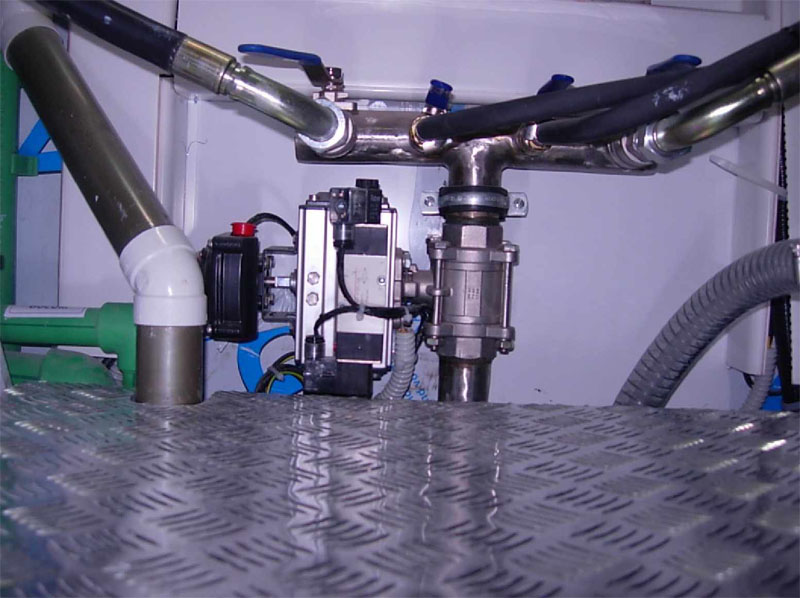 -emergency stop button for fuel distribution  -collectors for the fuel distribution system |
| E.03 VENTILATION SYSTEM Do not go near the vents with open source of fire, such as cigarettes or other spark producing items.See below drawing for the positioning of the vents. 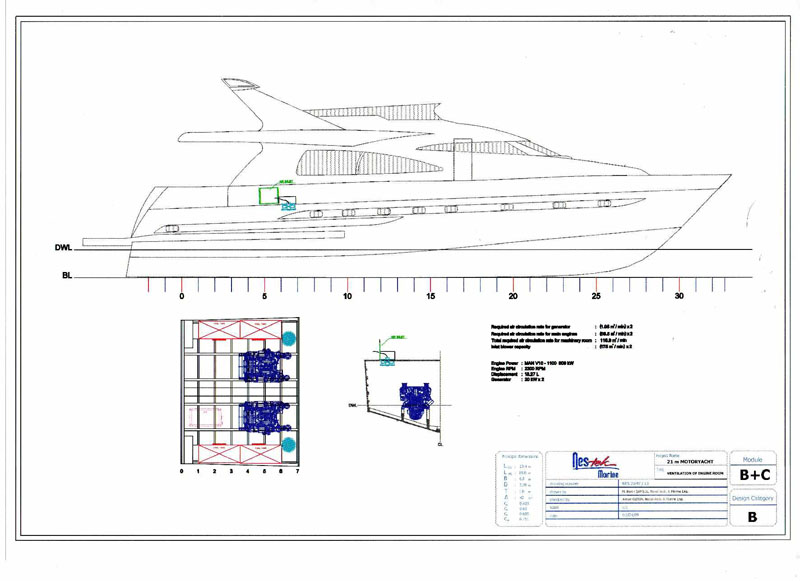 |
| E.04 BILGE PUMPING SYSTEM Your boat is equipped with electric bilge pumps and a manual operated bilge pump(in the engine room). If the electrical pump is automatic, it should be left on Auto position when the boat is in water. The bilge pumps must be checked for operation periodically. The bilge pumps are provided as a safety measure on your boat and should be used if water enters the bilges.  Running the electrical pumps dry will damage the pumps. Before starting using your boat please be familiarize with the positions of your bilge pumps and check whether they work or not before you sailaway.You must clean the filters of your bilge pumps from time to time.Please turn off your bilge pumps when you see a sign of fuel at your boats bilge,otherwise it will start automatically and discharge the fuel to the sea.This will cause a serious pollution at the sea.Clean the bilge from the fuel by your own means then be sure your bilge pumps are at operation again. Just at the below drawing, you can check the positions of your bilge pumps and the discharge outlets of your boat as a drawing. 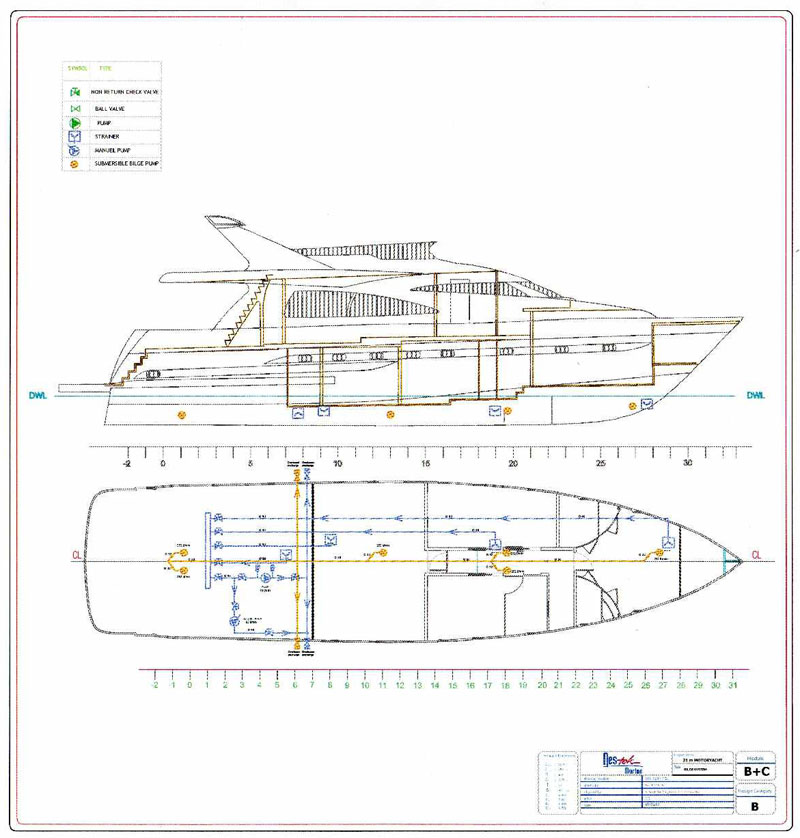 |
| E.05 STEERING SYSTEM A hydraulic steering system is supplied with your boat. The hoses and its connections must be checked regularly for wear and corrosion. It must be noted that periodical lubrication of the steering shaft with marine grease will prolong your steering system’s life and will make it easier to operate.Check the fluid level periodically. |
| E.06 FIRE EXTINGUISHING SYSTEM Your boat has an automatic fire extinguishing system at the engine room.The bottle is fixed to the starboard side locker at the cockpit.The system has a smoke and heat sensor that automatically discharges the bottles on the fire.The boat also is equipped with manual fire extinguishers.The minimum capacity of the extinguishers must be 8A/68B,so when replacing these bottles or the time for maintenance comes be sure that the capacities are according to the rules.Donot forget to maintain or replace the fixed system and the manual fire extinguishers according to their maintenance intervals stated on the bottles.Finally a fire blanket is located inside the locker at the kitchen and also at the flybridge(for the grill). The positioning of the fixed extinguisher for the engine room is like following: 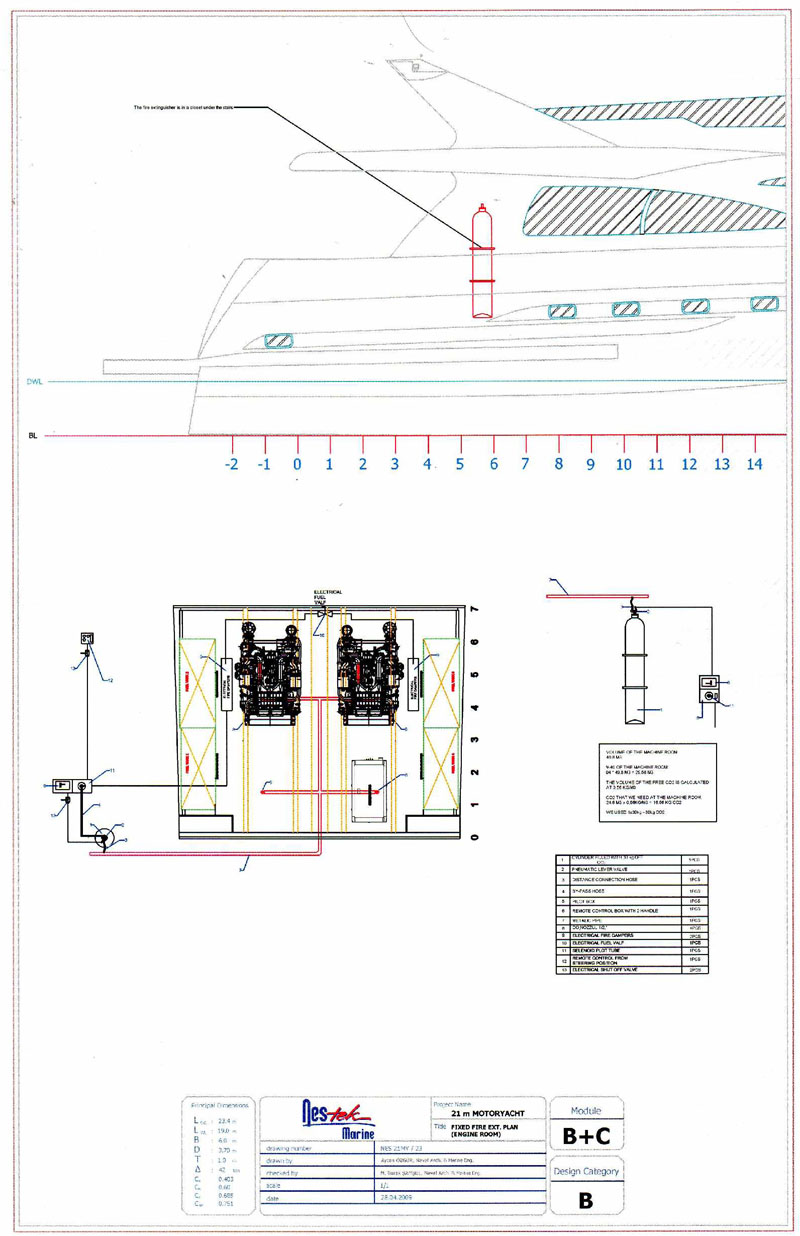 |
| E.07 LIFERAFT STOWAGE AND EMERGENCY ESCAPE Your boat has two liferafts supplied at your boats launching.The liferaft’s stowage is at the port and starboard back area of the flybridge.When things go wrong and an evacuation is inevitable,take out the liferaft from its stowage and throw it to the sea,it will inflate automatically.Please donot forget its periodical maintenances. In case of emergency your RIB can also be used as saving lives. 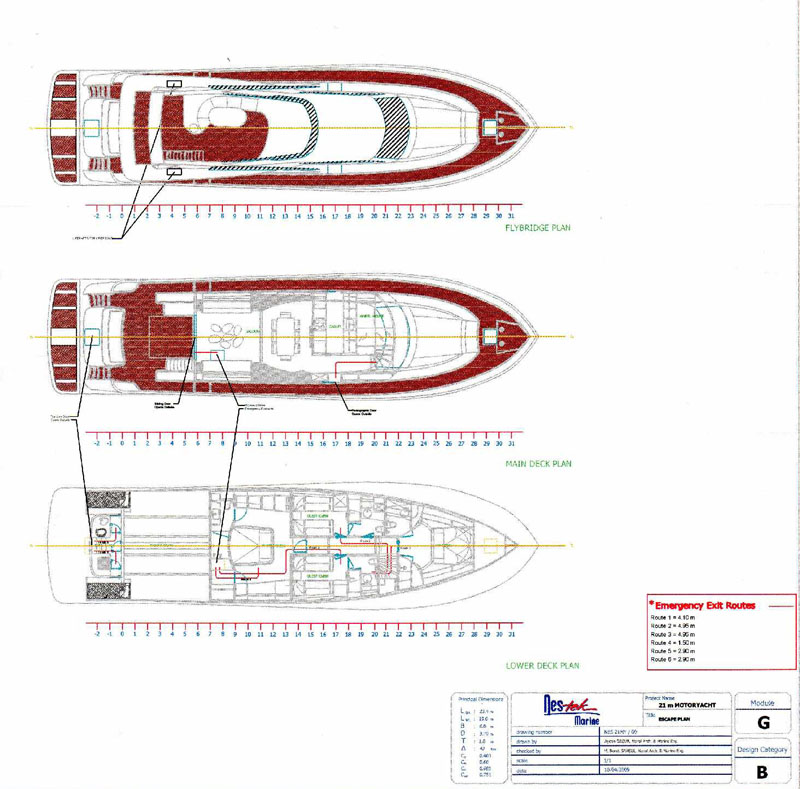 |
| E.08 OTHER SPECIFIC INSTALLATIONS There are some devices like paserelle,boat crane,vacuum system,water maker,black water sanitation system and such items installed to the boat.Please check them before you start using your boat and be familiar with the systems.If a maintenance will be made or additional equipment will be installed,do not hesitate to contact your yard.Do not let people who donot have enough knowledge on these systems or people who arenot qualified for this work to work on these systems.Check the following additional drawings. 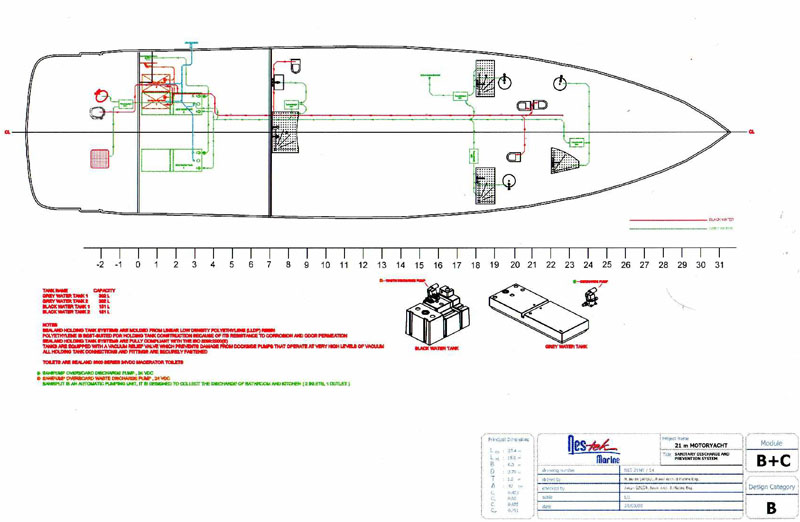 -sanitary dicharge and prevention system 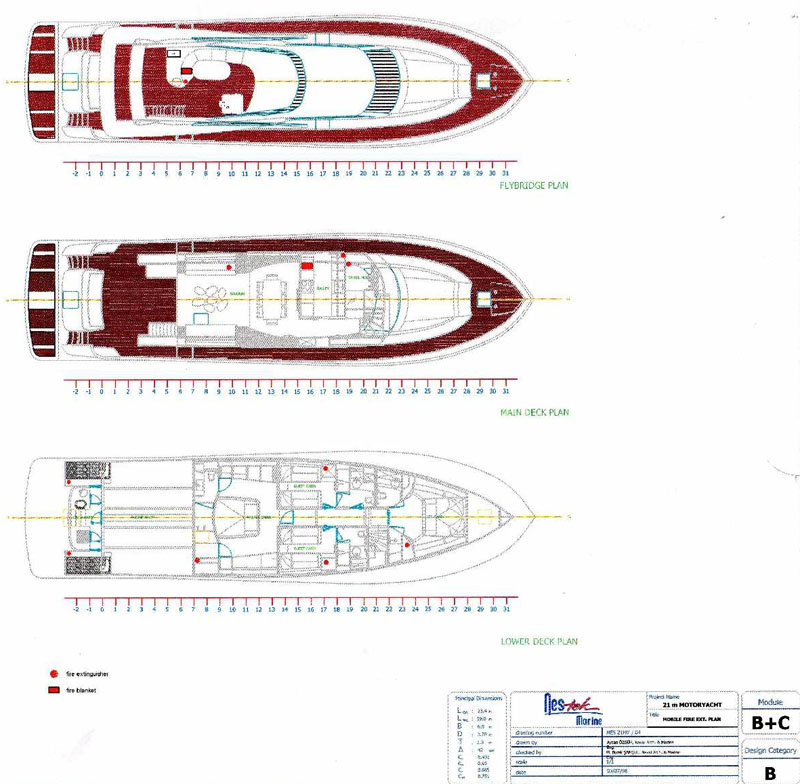 -mobile fire extinguishers positioning |
| F. ANCHORING ARRANGEMENT Please consult your dealer for the optimum anchor for your cruising area. Anchoring is done for two principal reasons: first, to stop for fishing, swimming, lunch, or an overnight stay and secondly, to keep you from running around in bad weather or as a result of engine failure. Anchoring can be a simple task if you follow these guidelines: · · Make sure you have the proper type of anchor (danforth/ plow/ mushroom/ shrapnel). · Be sure that the chain is properly attached to the anchor. · Select an area that offers maximum shelter from wind, current and boat trafffic. · Determine depth of water and type of bottom (preferably sand or mud). Calculate the amount of anchor chain you will need. General rule: 3 to 5 times as much anchor chain as the depth of water plus the distance from the water to where the anchor will attach to the bow. · Bring the bow of the vessel into the wind or current. · When you get to the spot you want to anchor, place the engine in neutral. · When the boat comes to a stop, slowly lower the anchor. · When enough length of anchor chain has been let out, back down on the anchor with engine in idle reverse to help set the anchor. · When anchor is firmly set, use reference points (landmarks) in relation to the boat to make sure you are not drifting. Check these points frequently. Anchoring a small boat by the stern has caused many to capsize and sink. The transom is usually squared off and has less freeboard than the bow. In a current, the force of the water can pull the stern under. The boat is also vulnerable to swamping by wave action. Do not anchor by the Stern!! |
| G. SPECIFIC MANUALS Your owner’s manual is provided in a bag,with other specific manuals about the systems,gensets and the engine In this bag, you will also find manuals relating to some of the equipment installed on your boat and extra stickers for your switch panel. Please familiarize yourself with the equipment by reading their manual before you use your boat. Consult our yard if there is any doubt about any equipment. |
| H. ENVIRONMENTAL CONSIDERATIONS Boating is an activity, which interacts with the environment. It is our responsibility to be wary of the environmental risks and take precautions to prevent any damage to it. When refueling take all precautions to prevent spillage. Fuel and oil spillage into water contaminates the environment. Never discharge, fuel, oil or other inorganic substance. Remember that overfilling a fuel tank will cause spills from the air vent of the tank. Also, contaminated bilge water pollute the waters-do not discharge contaminated bilge water unless you are required to do so due to safety reasons. Any waste, such as garbage, plastics, food, wood, chemicals and sewerage, collected during the trip must be disposed of properly after returning ashore. While underway, care must be taken not to create unneccesarry noise in habitant areas. Remember that this is not limited to engine noise but also means radio noise, music, yelling and other noise generated by the boating activity. Speed on no wake zones, ports, crowded navigation routes must be lowered to prevent wakes and accidents. Please have your engine maintained to the necessary standards to prevent excessive exhaust emissions, which pollutes water and air. When cleaning your boat, always try to use “biodegradable” marine product to safeguard the environment. Cleaners that contain aggressive chemicals such as phosphates, chlorine, solvents and petroleum derivatives must not be used. If you keep your boat in the water, sooner or later you will face marine growth problem on the bottom of your boat. Antifouling paint is used to prevent this. Please check the antifouling bottom paint regulations in your area and use a suitable one if necessary. |
| I. OPERATING YOUR BOAT |
| I.01 FIRST CHECK When you receive your boat and later on when you take your boat out for maintenance or restorations and before setting out to sea, first step should be a visual inspection of the hull, the cockpit, storage areas and the bilge, so you can find conspicuous damage and the necessary steps to do something beforehand. · Check the weather report to see if it is suitable for your intended trip. · Check all hoses and clamps for fir and that all drain hoses are in place and are not worn out. · Check all equipment, including your bilge pump(s) · Look for damages at the fuel hoses. Does it smell like fuel? · Have spare fuel on board. Check all rubber parts periodically and change them if they are worn out and /or damaged. · Look for damages in the cooling system and be sure that the engine leg is lowered into the water. · Check the remote control and the steering system. Are the cables for the remote control and steering fixed and operating freely? · Check the amount of fuel, may be with a. Do you have enough fuel for the intended trip? · Check your safety equipment. · Is the batteries connected correctly? Is there still enough distilled water in the cells? · Turn on your main electrical switch. After you have carried out the above checks, you can start the engine as described in your engine’s owner’s manual. |
| I.02 ELECTRICAL SYSTEMS Check the batteries,genset and electrical system before your trip. If you have to change something in the electrical system, you have to separate the batteries and genset from the system at first. Grease / lubricate poles of your battery to prevent corrosion and spark. For futher and detailed information please read the operating instructions of the respective equipment manufacturer (s). |
| I.03 AT THE PORT If the engine did not start during the first 20 or 30 seconds, turn the key back into off position and wait one minute before trying it again and consult your owner’s manual or dealer. After starting you should maneuver your boat only with low speed in the port, remembering that a motorboat has no brakes. It is enough if you put the engine in gear without increasing speed (idle speed), for manauvering. While casting off, you should be keen on the speed restrictions in the shore area. While maneuvering, pay attention to the characteristics of the boat with an outboard engine. Making sternway should be done with very low speed, so that there is always enough time and space for correction. |
| I.04 SUITABILITY Your boat has been certified according to the EC Directive for Recreational Crafts as a “motorboat designed for offshore voyages where conditions up to and including wind force 8 and significant wave heights up to and including 4 meters can be experienced”. Use your boat in the appropriate manner. If the conditions are not suitable for a safe cruise, please go only if you cannot avoid it. |
| I.05 VIBRATIONS If you feel vibrations in the hull while cruising, you should check the propellers and the shafts. Even a little piece of wood can damage the propeller or debris may cause vibration, which needs to be removed from the propeller. A damaged propeller can lead to severe damages at the hull or at the engine. Nylon bags are known to cause propeller cavitation if they come in contact while underway. Stop the engine, tilt and remove the nylon or other debris. Please check the steering gear from time to time and lubricate as necessary with marine grease. |
| I.06 SHIFTING Shifting should only be done if the engine is idling. Shifting must be done in a quick manner fo proper seating of the gears in the transmission. Slow shifting may damage your transmission. If you try to shift with engine revolutions higher than the recommended idle speed, you can cause damage to the boat, the engine or the gears. If you want to switch off the engine, please shift into neutral and do not accelerate anymore. You may switch off the engine by turning the ignition key into its off position. |
| I.07 FIRST OPERATING HOURS Please consult your engine’s owner’s manual for the break-in recommendations and use the break-in period to get used to your boat. Do not operate at high speed while in congested high traffic waterways or in weather and sea conditions of reduced visibility, high winds or large waves. Reduce speed and wake as courtesy and as safety consideration to yourself and others. Observe and obey speed limit and no wake zones. Observe Right of Way as defined by Rules of the Road and required by COLREG. Always be certain to have sufficient distance to stop or maneuver if required to avoid collisions. |
| J. SAFETY The NES 21 MY motorboat can reach high speeds. Therefore, it should be handled by trained and / or experienced persons only. Do not leave untrained persons or children without supervision on board. Do not let the ignition key on the boat. Maneuverability at high speeds is limited. Sudden turns may cause loss of control. Reduce speed before making sharp turns in either direction. Important safety warnings are found throughout this manual. Please read them carefully. |
| J.01 OPERATOR’S RESPONSIBILITIES Your water fun depends on you, your equipment and other people who, like yourself, enjoy spending leisure time on, in or near the water. Let’s take a look at your responsibilities: · Make sure the boat is in top operating condition and that there are no tripping hazards. The boat should be free of fire hazards and have clean bilges. · Safety equipment, required by law, is on board, maintained in good condition, and you know how to properly use these devices. · Inform a relative or friend where you are heading. · Have a complete knowledge of the operation and handling characteristics of your boat. · Know your position and know where you are going. · Maintain a safe speed at all times to avoid collision. · Keep an eye out for changing weather conditions, and act accordingly. · Know and practice the Rules of the Road ( Navigational Rules). · Maintain a clear, unobstructed view forward at all times. “Scan” the water back and forth; avoid “tunnel” vision. You are the key to safety on board! |
| J.02 OVERLOADING Never overload your boat with passengers and cargo beyond its safe carrying capacity. Too many people and/ or gear will cause the boat to become unstable. Always balance the load so that the boat maintains proper trim. Here are some things to remember when loading your boat: · Distribute the load evenly fore and aft and from side. · Keep the load low. · Keep passengers seated · Fasten gear to prevent shifting. · Do not exceed the capacities on manufacturer’s plate. |
| J.03 WEATHER You should never leave the dock without first checking the local weather forecast. You can get the weather information from the T.V, radio, local newspaper, on-line, or from the weather channels. At certain times of the year weather can change rapidly and you should continually keep a “weather eye” out. While you are out in a boat here are a few signs you can look for that indicate an approaching weather change: · Weather changes generally come from the west. Scan the sky with your weather eye, especially to the west. · Watch for cloud to build up, especially rapid vertically rising clouds. · Sudden drop in temperature. · Sudden change in wind direction and/ or speed. · Check the barometer on your boat, check it every 2 to 3 hours. A rising barometer indicates fair weather and rise in wind velocity; a falling barometer indicates stormy or rainy weather. |
| J.03.1 What To Do In Severe Weather · Put on your PFDs. · Turn on running (navigation) lights. · Head for nearest shore that is safe to approach, if possible. · Head bow of boat into the waves at about a 45-degree angle. · Keep bilges free of water. · Seat passengers on bottom of boat near centerline. · If your engines fail, trail a sea anchor on a line from the bow to keep the boat headed into the waves. Buckets will work as a sea anchor in an emergency. · Anchor the boat if necessary. |
| J.04 STAYING AFLOAT It is common belief that someone dressed in heavy clothing or waders will sink immediately if they fall overboard. This is not true. Air trapped in clothing provides considerable flotation, and bending the knees will trap air in waders, providing additional flotation. To stay afloat follow these rules: · Remain calm, do not thrash about or try to remove clothing or footwear. This leads to exhaustion and increases the loss of air that keeps you afloat. · Keep your PFD on. · Keep your knees bent. Float on your back and paddle slowly to safety. |
| J.05 WHAT TO HAVE ON BOARD ? The required safety equipment to have on board differs region by region. Check with your local regulations and obtain the required equipment before setting off with your boat. · VHF radio and/ or EPIRB (Emergency Position Indicating Radio Beacon) · Anchor, chain, rope- sufficient length · Radar reflector · Chart and Compass · Boat Hook · Visual Distress Signals · Spare Anchor · Heaving and Mooring Line · Fenders · Food & Water (Water extremely important) · First Aid Kit · Binoculars · Flashlight (with spare batteries) · Mirror · Searhlight · Tool Kit · Spare Parts- including fuses and bulbs · Ring Buoy · Spare Fuel · AM/ FM Radio |
| J.05.1 Life Jackets Life jackets (PFDs) are the most important safety equipment to have on board. Life jacket must be stored in an easily accessible place. Special care must be taken not to store life jackets under other equipment. It is important to note that children, people who cannot swim, elderly or handicapped people must wear life jackets at all times during boating. 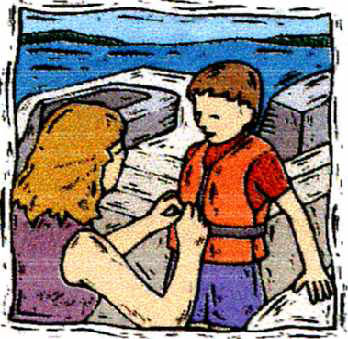 Follow the instructions on the life jackets and keep them in good order. Check your local regulations concerning approved life jackets to have on board. |
| J.05.2 Fire Extinguishers Maintenance Inspect extinguishers monthly to make sure that:  · Seals and tamper indicators are not broken or missing. · Pressure gauges or indicators read in the operable range. (Note: CO2 extinguishers do not have gauges.) · There is no obvious physical damage, corrosion, leakage or clogged nozzles. · Weight extinguishers annually to assure that the minimum weight is as stated on the extinguisher label. |
| J.06 VISUAL DISTRESS SIGNALS Please check with local authorities for the required visual distress signals. Even if non required in your region, it is advisable to carry them on board. Following is general information about available Visual Distress Signals. |
| J.06.1 Pyrotechnic Devices Pyrotechnic Visual Distress Signals must be approved, in serviceable condition, and readily accessible. · They are marked with an expiration date. Expired signals may be carried as extra equipment, but can not be counted toward meeting the visual distress signal requirement, since they may be unreliable. · If pyrotechnic devices are selected a minimum of three are required. That is, three signals for day use and three signals for night. Some pyrotechnic signals meet both day and night use requirements. · Pyrotechnic devices should be stored in a cool, dry location, if possible. · A watertight container painted red or orange and prominently marked “DISTRESS SIGNALS” or “FLARES” is recommended. Examples of Pyrotechnic Visual Distress Signals and associated devices include: · Pyrotechnic red flares, hand-held or aerial. · Pyrotechnic orange smoke, hand-held or floating. · Launhers for aerial red meteors or parachute flares.  Each of these devices has a different operating (burning) time. Check the label to see how long each pyrotechnic device will actually be illuminated. This will allow you to select a warning device better suited to the conditions where your boat will operate. |
| J.06.2 Non-Pyrotechnic Devices Non-Pyrotechnic Visual Distress Signals must be in serviceable condition, readily accessible, and certified by the manufacturer as complying current requirements. Electric Distress Light · Accepted for night use only · Automatically flashes the international SOS distress signal (...--...) Regulations prohibit display of visual distress signals on the water under any circumstances except when assistance is required to prevent immediate or potential danger to persons on board a vessel. All distress signals have distinct advantages and disadvantages. No single device is ideal under all conditions or suitable for all purposes. Pyrotechnic are universally recognized as excellent distress signals. All distress signals have distinct advantages and disadvantages. No single device is ideal under all conditions or suitable for all purposes. Pyrotechnic are universally recognized as excellent distress signals. However, there is potential for injury and property damage if flares not properly handled. These devices produce a very hot flame and the residue can cause burns and ignite flammable materials. Pistol launched and hand-held parachute flares and meteors have many characteristics of firearm and must be handled with caution. All boaters should be able to signal for help. Boaters must have current dated approved day and night signals for all boats operating on coastal and open bodies of water. Above information on Visual Distress Signals is only indicative. Please check with your local authorities for the proper visual distress signals for your area and intended us of your boat. Sound Producing Devices The navigation rules require sound signals to be made under certain circumstances. Meeting, crossing and overtaking situations are examples of when sound signals are required. Recreational vessels are also required to sound signals during periods of reduced visibility. |
| K. CARBON MONOXIDE HAZARD Do not forget that your engine produces exhaust fumes which contain the dangerous carbon monoxide (CO). Refrain from exposure to engine exhaust at all times. Passengers of boats operating at slow speed to engine may be exposed to exhaust fumes with following winds. Be wary of the dangers of Carbon Monoxide and avoid any direct or prolonged exposure. |
| L. MAINTENANCE |
| L.01 MARINE ENVIRONMENT It must be remembered that the marine environment is a very harsh and corrosive one. Especially saltwater, sun, spray, dust, chemicals in the air and other elements take their toll on your boat in short time unless it is protected and maintained properly. If your boat is used in saltwater, it is necessary to rinse it with fresh water after each use. Also it is highly recommended to polish your boat’s stainless steel parts every month. All metal hardware must be cleaned and treated with chrome cleaner and wax. |
| L.02 CLEANING Regular cleaning will keep the surface of boat in good condition for many years. You are advised to use completely biodegradable boat cleaning agents. Do not use scouring powder, solvents, ammonia and chlorine because they scratch and bleach the painted surface. If the surface is very dirty, rub it with boat polish, which is free of abrasives and silicone after washing. We recommend you to take special marine product, which you can buy in boat shops and chandleries. |
| L.03 BELOW WATERLINE The underwater coating- antifouling paint- should be renewed periodically, if the boat will remain in water for longer periods. This prevents the growth of algae and shells. You should also clean the underwater area, from time to time, with high-pressure water cleaner when out of water. Do not clean the underwater areas of your boat mechanically (hard brush or scouring pads) as this will scratch the bottom of your boat. Always apply the chemicals following their manufacturers’ directions. Take care that no environmental hazard is created during use of these chemicals. |
| L.04 BILGE Your boat is equipped with a bilge. For the bilge pumps to function properly, in case of necessity, your boat’s bilge must be free from debris that can clog the pump. Check your pump’s strainer periodically and keep your bilges clean. Bilges must never be cleaned with flammable solvents |
| L.05 COCKPIT PERSENNING Your boat comes equipped with a persenning. The transparent plastic can be scratched easily if not cleaned properly. When cleaning use clean, lukewarm fresh water and wipe with a soft cloth. |
| L.06 STAINLESS STEEL Stainless steel is not entirely resistant to corrosion and must be looked after properly and regularly. To do this, always wash stainless steel equipment with fresh water and soap after each use. Do not use scouring powders, abrasives, bleach or acids when cleaning. Whenever you see sign of rust on your stainless steel, use chrome polish to remove them. If this is not done, these rust sports may develop into pitting which will ruin the stainless steel. When waxing your boat, wax your stainless hardware too. |
| L.07 REPAIRS Please consult our yard who can give you good advice and can order the suitable spare parts if you want to repair your boat by yourself. You should leave extensive repair at the hull or at the engine to experts. Do not attempt to repairs, which you are not trained to handle. Your dealer will take over such repairs and will give the job to an expert. |
| L.08 CORRECT MATERIALS AND COMPONENTS NES TEKNOLOJI Ltd. boats are designed for the harsh marine environment and are certified for applicable safety standards. To keep these qualities, please let your dealer handle work and repairs on your boat. You could endanger your safety and lose your warranty because of improperly installed equipment or wrong choice of equipment. If you order spare parts, always order quoting your boats’s/ engine’s serial number.Craft serial number (CIN), on NES TEKNOLOJI Ltd. boats, is found on starboard side of the transom and is made up of lexan sheet,riveted and epoxied to the hull. |
| L.09 WINTER STORAGE For wintering, your boat can be lifted out of the water by a special crane with traverse. If the boat will be lifted by slings, do not allow the slings to touch any underwater fittings. Adjust the balance of the boat so that the bow is slightly higher than stern. It is advisable to winter your boat in a protected area. If you are going to winter your boat outside, it is highly recommended to thoroughly clean it before covering. This will prevent the dirt to settle on the finish of the boat. Take precaution so that your boat remains ventilated during storage to prevent the formation of mildew and corrosion. Also remember to take precautions for freezing water inside the boat, hoses and pipes. Disconnect and remove the batteries when the boat is in long-term storage. Store your batteries in a dry, ventilated place and charge it according to manufacturer’s recommendations. If the boat will remain on the craddle for a long time, take special care that the weight of the boat is equally distributed on the touching points of the craddle. Fuel tank: If there is leftover fuel in the tank, you should empty it and let some air in. You should cover open tanks, conduits and hoses with cloth or gauze at their ends. This will enable ventilation but prevent dust from settling in. It must be remembered that your boat will not be covered for warranty due to problems associated with improper storage. It is advised that your dealer handles the storage preparation for your boat. |
| M. INSPECTION Regularly inspect all hardware, hose clamps, fittings, tanks, thru hulls and sealed areas for leakage or other abnormalities. Check your boat’s electrical connections for corrosion and fraying. You must inspect your boat at the beginning of the season and during the season periodically. |
| N. LAST REMARKS This manual follows the instructions of the harmonized European norm EN 10240. We hope that it will help you to familiarize yourself with your boat and its systems. We also have tried to give you valuable safety information. However, this manual will not teach you seamanship and the safety information is provided as basic infirmation. It is highly recommended that users of such boat obtain proper training before attempting to use it. It must be remembered that safety on board belongs to the skipper’s area of responsibility and it is obvious that there has to be personal safety equipment for all persons on board. Also obtaining and maintaining distress signals, first-aid-kit and repairing tool belong to the skipper. It is the skipper’s responsibility to maintain and inspect the boat properly and to prepare the passengers and the boat for the journeys. The EC Directive has a special eye on fire protection. Therefore, the fire extinguishers must be maintained regularly. It is the task of the skipper to tell the crew how to handle all the safety equipment. It must be remembered that taking these safety meansures are cheap insurance for fun filled trips with your boat.  We take this opportunity to thank you, once again, for choosing NES TEKNOLOJI LTD. |
| O. OTHER (OWNER’S GUIDE & INSTALLATION INSTRUCTIONS) LINK AND PDF FILES YAMAHA-F30A-F30B.pdf ---(BOTMAR -Murat Bey 0252 419 0107) WHALE_MARINE.pdf VITRIFRIGO ...(Türkiye Temsilcisi (MARINTEK ) irtibat Tel: 0216 317 1010 Emre Bey, (İbrahim Selamet 0533223809)) VETUS Extractor Fan VETUS NSF 16, 19, 25, 38 VETUS NSF16S, NSF16DS VDO TACHOMETER TECMA Elektrikli Tuvalet Sistemleri SONY CD/DVD PLAYER SOMFY RTS-DC25 SOMFY PERDE KUMANDA SIEMENS ANKASTRE SIDE-POWER Single Control Panels SIDE-POWER Automatic Main Switch SIDE-POWER sp155tc SIDE-POWER sp200tc SIDE-POWER sp240tci SIDE-POWER Stern Thruster SIDE-POWER TwinC_IPC_Thruster SIDE-POWER Tunnel Cut SEA TEL 124591 SEA TEL 124769 SEA LED SAMSUNG LCD TV Quick Start Guide SAMSUNG LCD TV USER MANUAL PLASTIMO COMPASS FOOD WASTE DISPOSER Northstar 2009 Catalog Northstar 6000i Quickstart Guide Northstar 6000i NETWORKED NAVIGATION SYSTEM Northstar 491 Echo Sounder Operations Manual Northstar 491 Echo Sounder Installation Manual Northstar NS3300 AutoPilot Manual Northstar NS3300 AutoPilot Installation Manual Northstar NS100 Northstar NS100 Installation NEXT 2000 CX NEXT 2000 FTA NEXT MANUAL 17500 FTA&CX MASTERVOLT CHARGEMASTER ENG MASTERVOLT CHARGEMASTER TR MASTERVOLT CHARGEMASTER KULLANIM KITABI MASTERVOLT CHARGEMASTER MASS TR MASTERVOLT CHARGEMASTER MASS SINE ENG MARCO KORNA LOFRANS LEWMAR MEDIUM PROFILE HATCH LEWMAR LOW PROFILE HATCH CMOS KAMERA JOHNSON PUMP 2009 CATALOG JOHNSON PUMP SERVICE KIT JABSCO 255 SL JABSCO 135 SL ISOTEMP Slim/B Water Heater GROHE GOLDMASTER D-SMART GEBERIT FRANKE DAVLUMBAZ ELECTRO SCAN ELECTRO SCAN EST12, EST24 and EST32 ELECTRO SCAN FOUR GALLON SALT FEED SYSTEM ELECTRO SCAN FOUR GALLON SALT FEED SYSTEM WITH PUMP SEA LAND Dometic Toilets & Sanitation Systems SEA LAND Dometic HOLDING TANK SYSTEM SEA LAND Dometic Sanitation Dolphin Charger Dolphin Charger & Accessories Boyut Marine Ultra Çapa BOSE Marin Speaker System BANG OLUFSEN Beo Center 2 BANG OLUFSEN Beo Link Passive BANG OLUFSEN Beo Sound 4 AYVAZ MG 33 ARIMAR CAN SALI AQUA SIGNAL Navigation Lights AIRMAR Thru-Hull, Metal Stem Depth Transducer AIRMAR Triducer Multisensor with Vale SEAKEEPER GYRO INSTALATION DETAILS SEAKEEPER GYRO PART LIST KOHLER JENERATOR ...Türkiye Temsilcisi DENPAR --MARMARIS SERVİSLER --(MARLIN) Erdem Eke 0532 332 5866 --(DES MAKINE) Hayati Catan 0532 746 1690 HEADHUNTER MACH 5 - www.headhunterinc.com HEADHUNTER X-Caliber - www.headhunterinc.com |
| P. WATER SYSTEMS |
P.01 GRAY WATER TANKS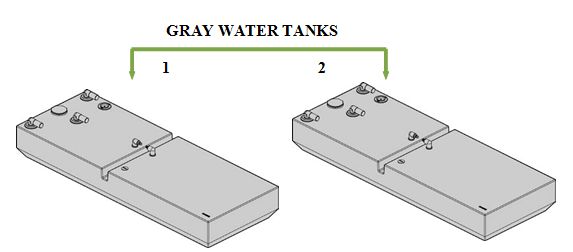 1.Birinci tanktan doğrudan denize vermek için 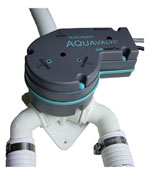 Şekildeki 3 yollu vana overboard konumunda olmalıdır. Şekildeki 3 yollu vana overboard konumunda olmalıdır. Vananın konumunu şekildeki göstergeden takip ediniz. Vananın konumunu şekildeki göstergeden takip ediniz.2.Birinci tanktan ikinci tanka vermek için Vananın konumu holding tank da olmalıdır.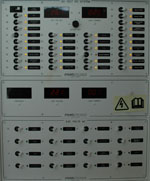 Konsol birinci panelde(24 volt DC) 28. sigorta (Graywater pump auto) açık olmalıdır. Konsol birinci panelde(24 volt DC) 28. sigorta (Graywater pump auto) açık olmalıdır. Konsoldaki yan panelden gray water disc. butona basmak yoluylada tankları denize boşaltabilirsiniz. Konsoldaki yan panelden gray water disc. butona basmak yoluylada tankları denize boşaltabilirsiniz.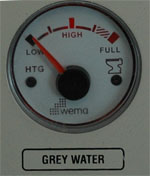 Yine aynı panelden tankların doluluk oranlarını görebilirsniz. Yine aynı panelden tankların doluluk oranlarını görebilirsniz. |
P.02 BLACK WATER TANKS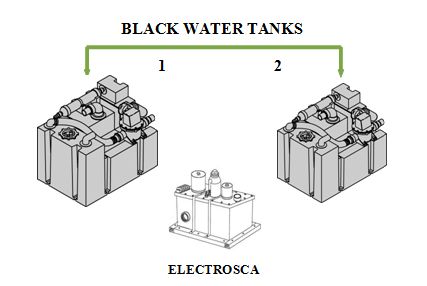 1.Tank suları doğrudan denize verilmek istendiğinde (seyir esnasında); 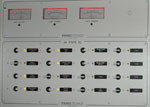 Makine dairesindeki 24 volt DC panodan ikinci sigortanın(waste treatment) açık olduğundan emin olunuz. Şekildeki birinci 3 yollu vana overboard konumunda olmalıdır. Vananın konumunu şekildeki birinci göstergeden takip ediniz. Makine dairesindeki 24 volt DC panodan ikinci sigortanın(waste treatment) açık olduğundan emin olunuz. Şekildeki birinci 3 yollu vana overboard konumunda olmalıdır. Vananın konumunu şekildeki birinci göstergeden takip ediniz.2.Birinci tanka alış ve electroscandan geçirerek denize atış (Hassas olmayan koylarda ve denizde); 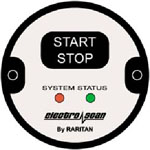 Cihazda system ışığı yanmalıdır. Cihazda system ışığı yanmalıdır. Ekranda ready to flush yazmalıdır. Ekranda ready to flush yazmalıdır.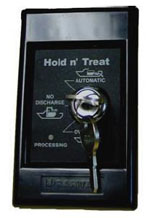 Anahtar automatic de olmalıdır. Vananın konumu holding tank da olmalıdır. Konsol birinci panelde(24 volt DC) 29. sigorta (Blackwater aft) açık olmalıdır. Anahtar automatic de olmalıdır. Vananın konumu holding tank da olmalıdır. Konsol birinci panelde(24 volt DC) 29. sigorta (Blackwater aft) açık olmalıdır.3.Birinci tanka alış ve electroscandan geçirerek ikinci tanka alış (Çok hassas koylarda); Şekildeki ikinci 3 yollu vana da holding tank konumunda olmalıdır. Konsoldaki yan panelden black water butona basmak yoluyla da tankları denize boşaltabilirsiniz. |